01//THE ILLUSION OF STABILITY
One supplier, zero problems. Until there are.
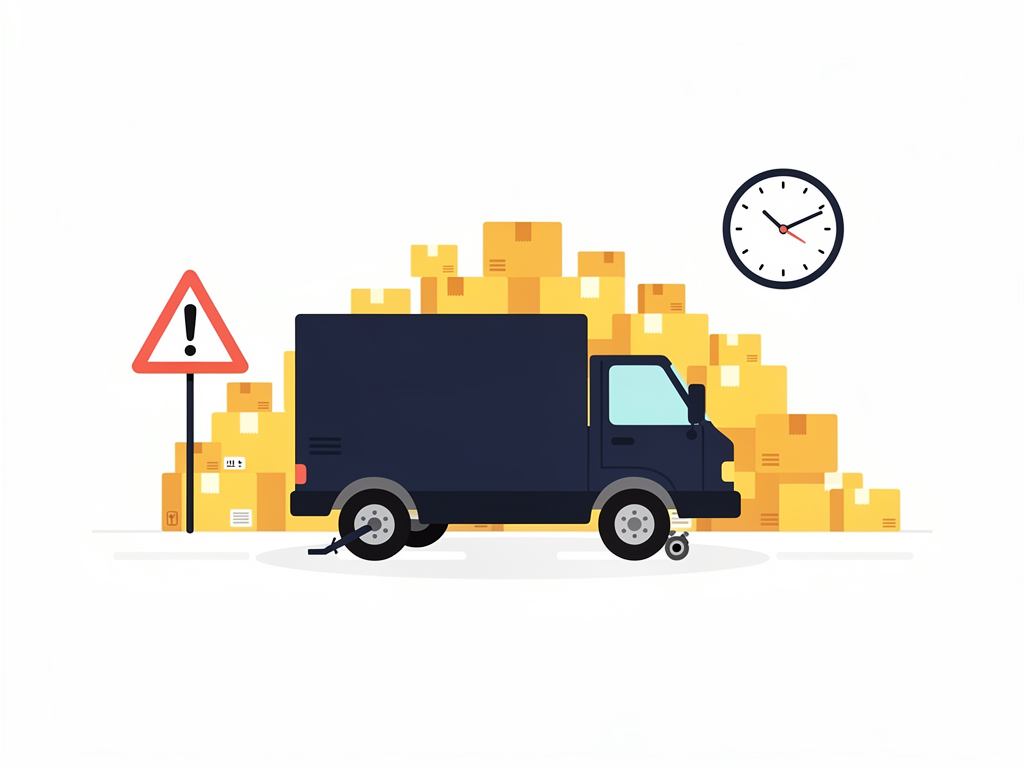
There is a tempting logic in having only one last-mile supplier: a contract, an integration, a point of contact, an invoice. Less operational complexity. Easier to manage. It works well when you're making 500 shipments a month and your coverage is a single city.
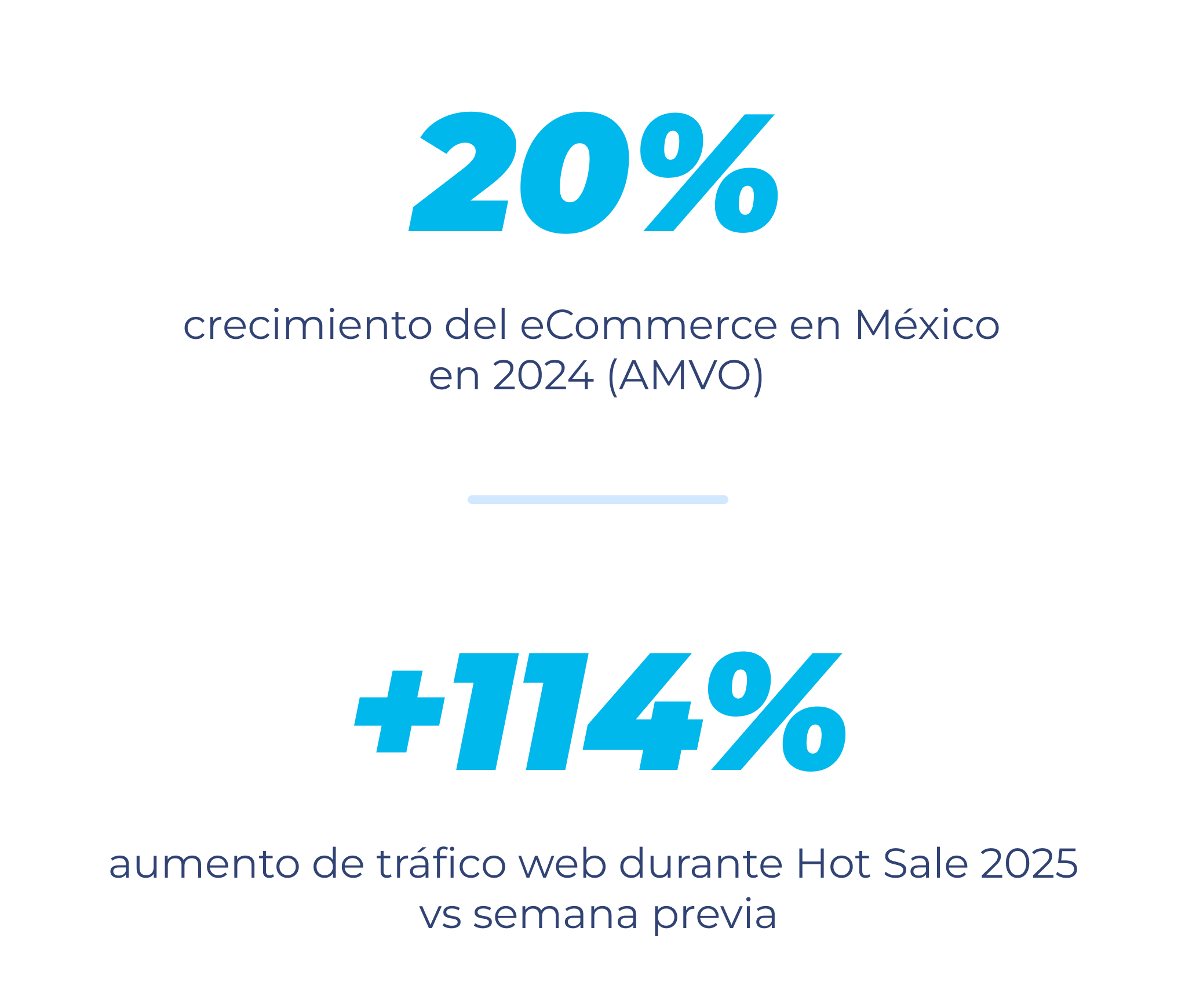
The problem is that that logic breaks down exactly when you need it most: when you grow up. When you go from 500 to 5,000 shipments. When your eCommerce expands from CDMX to Guadalajara, Monterrey and Bogotá. When the Hot Sale generates you 114% more web traffic than the previous week and your single supplier doesn't have the capacity to absorb the 19.2 million orders moved by the event.
According to the AMVO, eCommerce in Mexico grew 20% in 2024, reaching MXN $789.7 billion in sales. Statista projects that the market will exceed USD 35 billion in 2025. But last-mile infrastructure didn't grow at the same rate. The result: operations that sell as an enterprise but deliver as a startup.
Sources: AMVO via T21 · Statista · AMVO Hot Sale 2025
02//THE SYMPTOMS
Three Signs That Your Single Provider Is Already Costing You
1) Failed orders at peak of demand. Your provider is capable of your normal operation. But in Hot Sale, Buen Fin, Christmas or any strong promotion, it's not enough. Orders are delayed, cancellations go up, and your customer service team becomes an apology center. Every failed order isn't just a lost sale. He's a customer who probably won't come back.
2) Cover with gaps. Your provider covers CDMX and Monterrey well, but in Querétaro it takes 48 hours and in medium-sized cities it just doesn't arrive. You sell to all of Mexico (or to all of Colombia, or to all of Peru), but your actual delivery capacity has gaps that your customer discovers after paying. That destroys trust.
3) Unbeatable pricing. When you have only one vendor, you don't have a benchmark. You don't know if the MXN $85 shipping rate in Guadalajara is competitive or if you could be paying $55 with another carrier. Without competition there is no negotiation. Your provider knows this. And your rates reflect that.
03//THE REAL COST
How much it costs your operation to rely on just one
Let's make numbers with a real operation. An eCommerce enterprise in Mexico that ships 10,000 monthly shipments with a single supplier at an average rate of MXN $90 per shipment (market reference according to package aggregators). Monthly delivery cost: MXN $900,000. Annual: MXN $10.8 million.
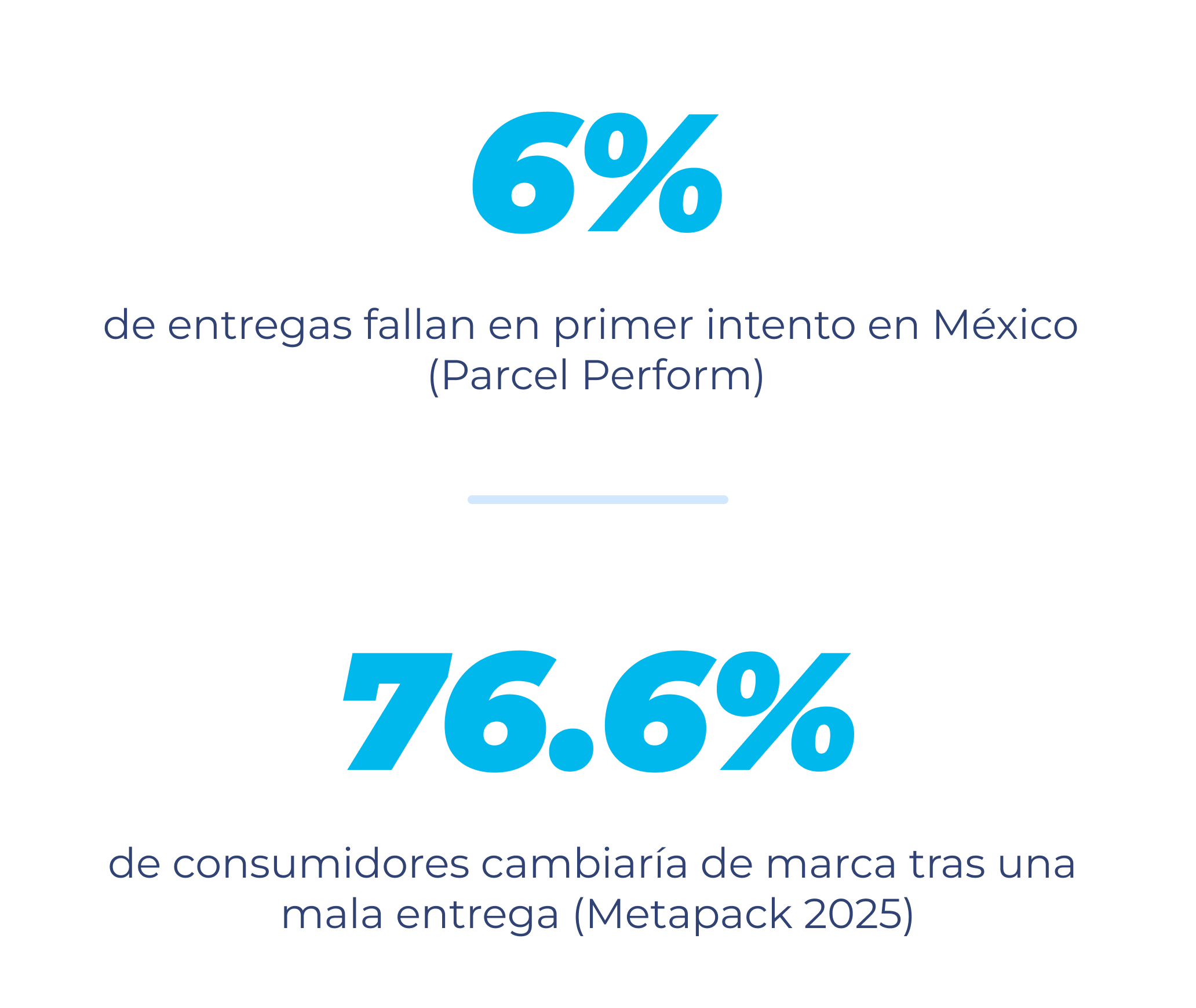
Now let's see what doesn't appear on the bill. According to Parcel Perform, the success rate at the first delivery attempt in Mexico is 94%, which means that 6% fails. In 10,000 shipments, that's 600 that require a second attempt or return. According to Loqate, the global average cost of a failed shipment is approximately USD $17 (about MXN $340). If we apply that cost to your 600 failed shipments, the hidden cost is around MXN $204,000 per month. Casi MXN $2.4 million per year in deliveries that didn't work the first time.
And that's not counting the most expensive cost of all: the customer who doesn't return. According to Metapack's Ecommerce Outlook 2025 study, 76.6% of consumers would switch brands after a bad delivery experience. It's not a typo. Three out of four customers. If your failure rate affects 600 customers per month and you lose 76%, that's 456 customers who go to your competition every month. With an average lifetime value of MXN $2,500, you're leaving MXN $1.14 million monthly on the table. In future value, not in direct cost. But it's money that's never going to come.
Sources: Parcel Perform 2023 · Loqate · Metapack 2025
04//THE NEW STANDARD
Operations that scale have multiple vendors. The others have excuses.
The logistics teams of the largest retailers in LATAM no longer asking “who is our delivery provider?” They ask “how many suppliers do we have assets and how are we allocating them?” It's a change in mentality that separates operations that grow on margin from those that grow with pain.
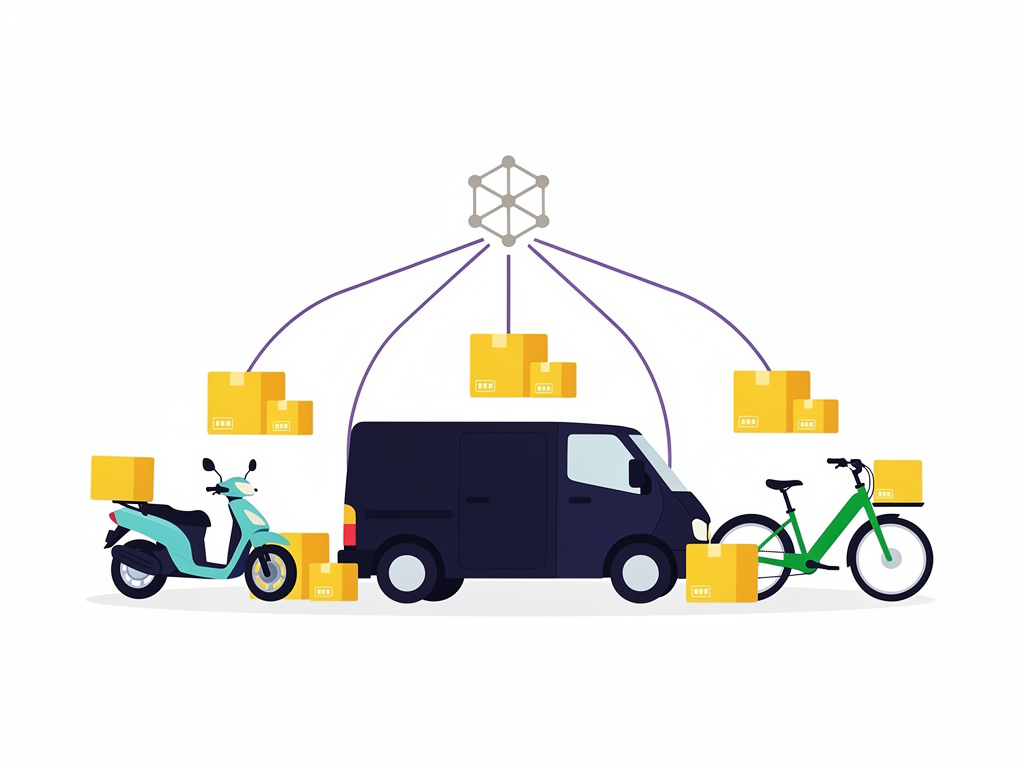
The model is called multi-vendor orchestration. The idea is simple: instead of depending on one supplier that does everything (right or wrong), you connect multiple last-mile providers and assign each shipment to the one that can do it best according to area, package size, schedule and cost.
It's not having three contracts and assigning them manually. That's worse than having just one, because you multiply complexity without gaining efficiency. Real orchestration is technological: a single integration that connects all your suppliers, with automatic assignment rules, unified tracking for your customer, and full visibility for your operations team.

05//HOW DOES IT WORK
One integration, multiple vendors, intelligent allocation
An order enters your system. The orchestrator evaluates in real time: where is the destination? How much does the package weigh? What providers are available in that area right now? Which one offers the best cost-speed ratio? And assign. In seconds. No manual intervention.
Provider A is excellent in Mexico City but expensive in the province. Provider B covers medium-sized cities at a good price but doesn't do same-day. Provider C is your own fleet that you use for urgent orders in nearby areas. Every order goes to the supplier that best solves it, not the only one you have.
For your client, nothing changes. You receive a single tracking number, a single notification flow, a single experience. For your operations team, everything changes: they see in a single dashboard which supplier is delivering what, where the bottlenecks are, and what the actual rates are by zone.
And when a vendor fails (because it's going to happen), the system has automatic fallback. If supplier A is unable to pick up within 30 minutes, the order is reassigned to supplier B. Your client doesn't know. Your operation doesn't stop. That resilience is impossible with a single vendor.
06//THE NUMBERS
What a trade of 10,000 shipments per month earns by diversifying
Let's take the same operation: 10,000 monthly shipments. Pay today MXN $90 average per shipment with a single supplier. With multi-vendor orchestration, the weighted average rate drops to MXN $69, because each shipment goes to the most competitive supplier for that specific route.
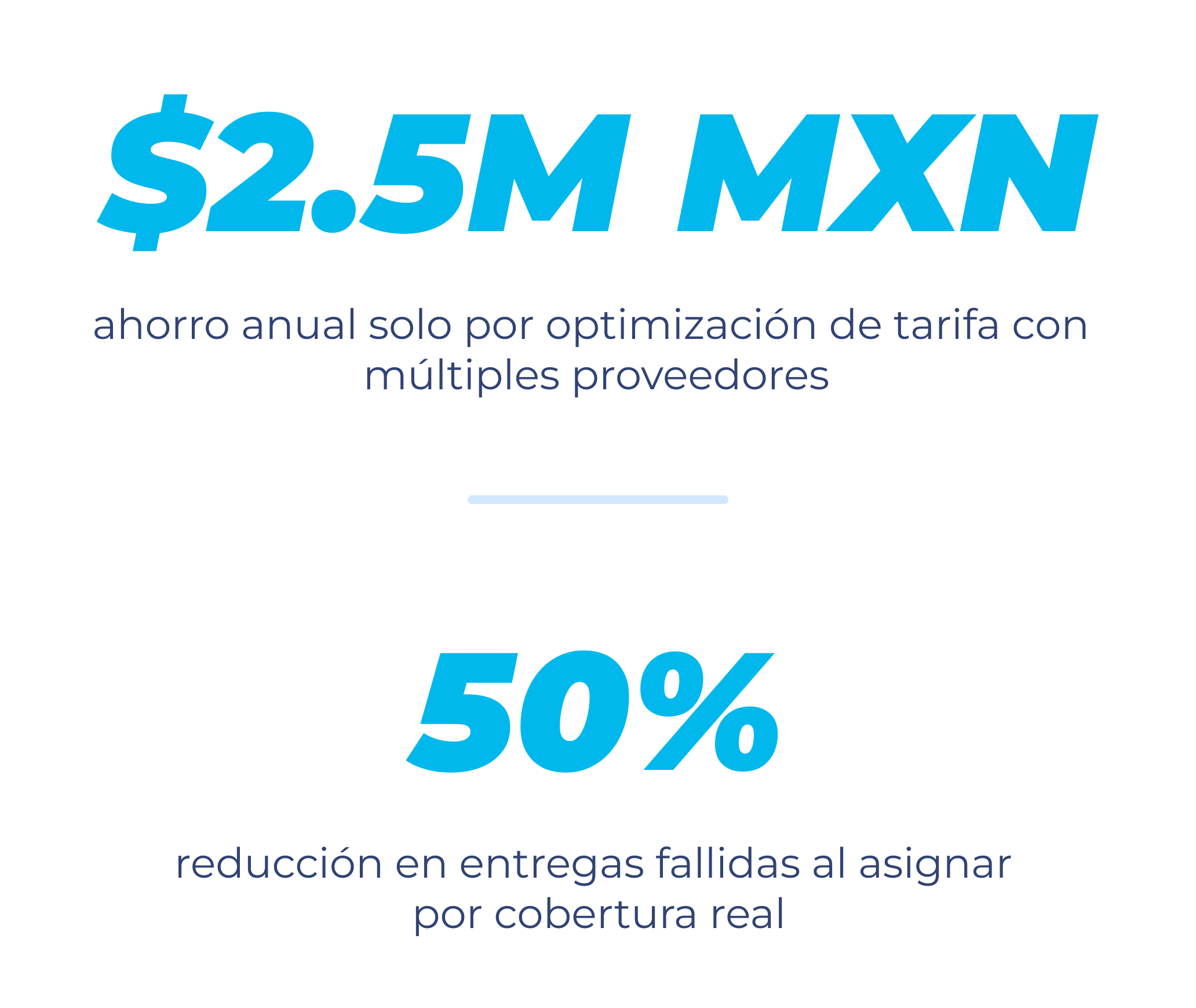
Direct savings on rates: MXN $210,000 per month. MXN $2,520,000 per year.
But the fare savings are only part of it. The failed delivery rate drops from 6% to 3% because orders go to suppliers with real coverage in each area (not to a supplier that “also arrives” but badly). That reduces reattempts and returns by half. With a cost of MXN $340 per failed shipment, you go from spending MXN $204,000 to MXN $102,000. Additional savings: MXN $102,000 per month.
And customer retention improves because the delivery experience is consistent. If you recover even 20% of the customers you previously lost due to failed deliveries, you are recovering MXN $230,000 monthly in lifetime value.
Adding up: savings in fees + reduced failures + improved retention = an impact of more than MXN $6.5 million per year for an operation of 10,000 shipments. And that's conservative.
07//THE WINDOW
Enterprise eCommerce in LATAM has 18 months to solve its last mile
The last-mile market in Latin America reached USD 11.85 billion in 2024, according to IMARC Group, and continues to grow in double digits. That growth will attract more suppliers, more technology and more competition. Operations that already have the infrastructure to orchestrate multiple vendors will capture that efficiency from day one. The others will continue to negotiate rates with their single supplier while their competitors deliver faster and cheaper.
Amazon already operates with dozens of last-mile providers in each market. Mercado Libre built Mercado Envios with a multi-vendor network from the start. They didn't do it because it's easier. They did it because it's the only way to scale up without delivery becoming the bottleneck.
You don't need to be Amazon to operate like Amazon. You need the same logic: multiple vendors, intelligent allocation, full visibility. The technology to do so already exists and is now accessible for operations of 5,000 shipments and up.
Sources: IMARC Group
IN SHORT:
A single vendor is a single point of failure disguised as simplicity. It works when you're a kid. When you grow up, every peak in demand, every area without coverage and every unbeatable rate reminds you that simplicity comes at a price.
Multi-vendor orchestration isn't complexity. It's control. Single integration, multiple vendors, automatic assignment. Your customer sees a unified experience. Your team sees everything on a dashboard. Your CFO sees MXN $2.5M+ a year in fee savings alone.
Those who have already diversified their last mile are delivering faster, cheaper and with fewer failures. Those who don't are subsidising the inefficiency of their sole supplier with their own margin. The window to move is now.
Actionable Framework:
If your operation dispatches more than 5,000 monthly shipments and you want to see how much you could save with multi-vendor orchestration, we can run the numbers with your real data.


