01//THE PHENOMENON:
1,200 kitchens without a dining room, and counting
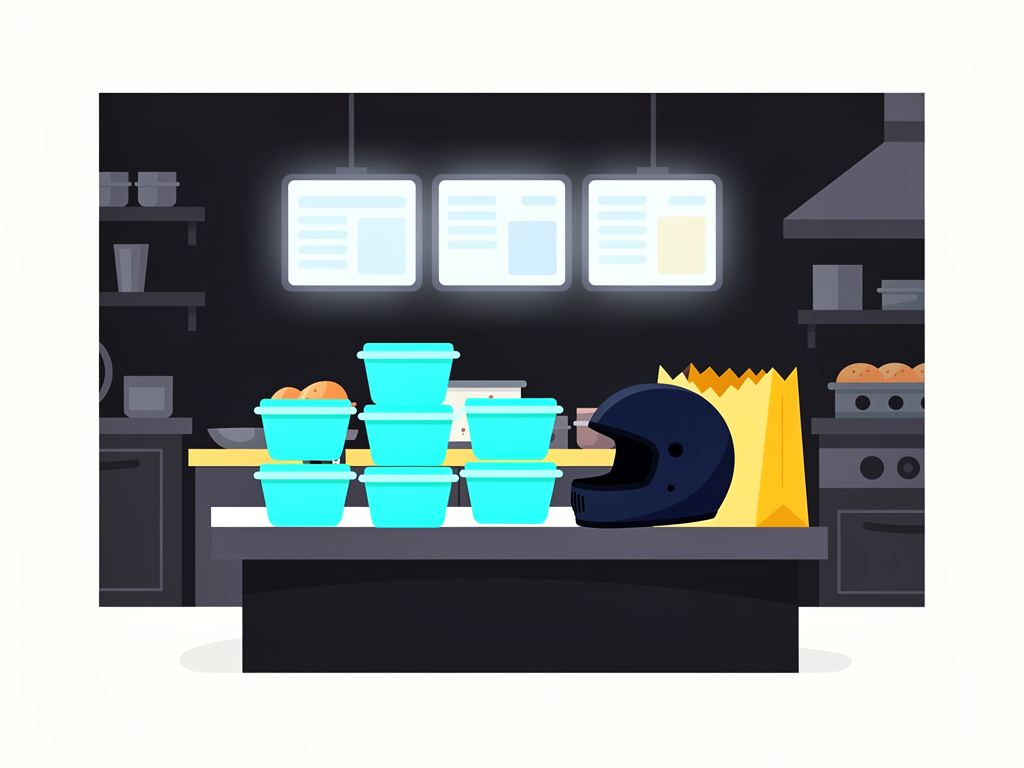
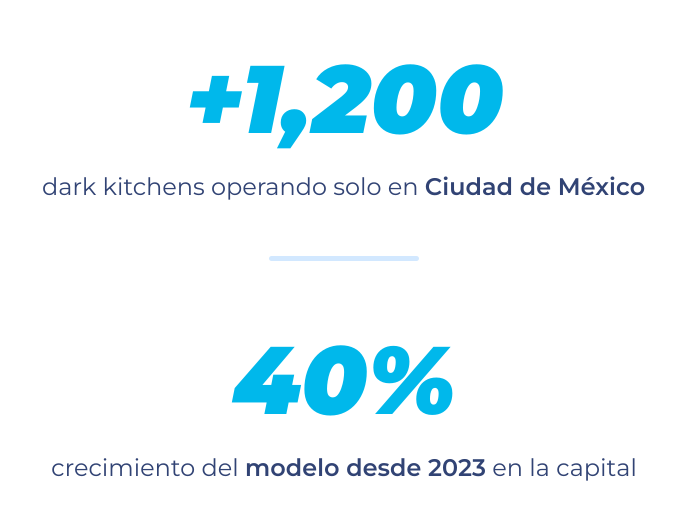
If someone had told you in 2020 that the future of food in Mexico was an industrial room with no tables, no waiters and no street sign, you would have told them they were crazy. Six years later, they operate in Mexico City alone more than 1,200 dark kitchens. Kitchens designed exclusively for delivery, without attention to the public. Growth since 2023 exceeds 40%.
The numbers tell the story: the food delivery market in Mexico closed in 2025 USD 4.8 billion, and the projections for 2026 point to USD 5.6 billion. Dark kitchens capture a growing portion of that pie because they solve an equation that traditional restaurants can't: less fixed cost, more geographic reach, and the ability to operate 5, 10 or 15 virtual brands from a single space. An 80-square-meter store in Polanco that used to be a taqueria now operates three concepts of sushi, two of wings and one of healthy bowls. All from the same fryer.
This is not a trend. It's a structural change in how food is produced and distributed in large cities in LATAM. Bogota, Lima, Santiago and São Paulo are experiencing exactly the same thing.
Sources: Well informed · Statista
02//THE PROBLEM THAT NOBODY TALKS ABOUT:
They grow fast, but they deliver with their hands tied
This is where the story gets interesting, and a little uncomfortable. Most dark kitchens in Mexico rely on a single platform to deliver their orders. Rappi, Uber Eats, or DiDi Food. Sometimes two. Rarely three. And they almost never have their own fleet.
The uncomfortable question is: if your business exists only for delivery, how is it possible that you don't control your own delivery?
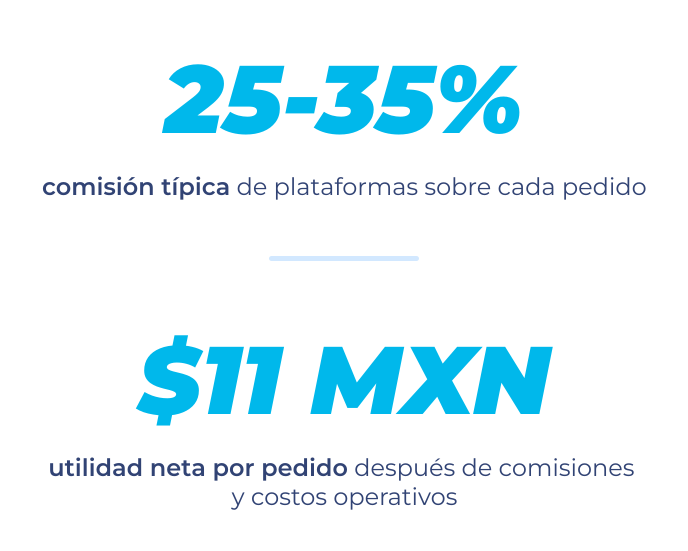
Platform fees range from 25% and 35% per order. For a traditional restaurant with a full dining room, that commission hurts but doesn't kill. Delivery is an additional channel. For a dark kitchen, delivery is the only channel. That commission is literally your cost of existing. And when a platform decides to change its visibility algorithm, modify coverage zones, or raise the commission half a point, you don't have plan B. Your plan B is to pray.
The problem worsens during peak hours. Friday at 8pm, your kitchen has 40 orders ready and the platform doesn't have enough delivery people in your area. Orders are delayed 15, 20, 30 minutes. The customer cancels. You paid for the ingredients, the labor, the gas, and you have nothing to show for it. Multiplied by every Friday of the year, that's silent bleeding.

03//THE NUMBERS:
What commissions do to your margin, with calculator in hand
Let's do the math. An average dark kitchen in Mexico City handles an average ticket of MXN $180. With a 30% commission, you have MXN $126 left. Subtract the cost of ingredients (35-40% of the original ticket, say MXN $68), packaging (MXN $12), pro-rated rent and services (MXN $15), and labor (MXN $20). You are left MXN $11 of profit per order. Eleven pesos.
That's what's left after the platform takes its share. And the commission is a percentage, so the more you sell, the more you pay. An MXN $350 combo loses MXN $105 in commission only. The more your ticket grows, the more you give to the middleman grows.
Think of it this way: every percentage point of commission is multiplied by every order, every day, every month. A dark kitchen that dispatches 3,000 monthly orders is transferring between MXN $135,000 and $189,000 per month in commissions. Per year, that exceeds Two million pesos. Silver that comes out of your kitchen and never comes back.
04//THE OUTPUT:
Own channel and own cast: the two levers that change the equation
If the problem is depending on a single platform that charges you 30%, the way out is not to complain about the commission. It's building alternatives. And there are two specific moves that any dark kitchen can make today.
The first: develop your own sales channel. A website, WhatsApp Business, or both. A place where the customer buys directly from you, without an intermediary. This is where the economy changes radically, because not only do you eliminate the commission from the platform, but Delivery ceases to be a hidden cost that eats away at your margin. On your own channel, you charge the customer a shipping fee of MXN $39 or $49, and that income goes directly to cover the cost of your delivery provider (who charges you a fixed rate of between MXN $35 and $55). In most orders, the shipping paid by the customer fully or almost completely covers the cost of delivery. Your MXN $180 ticket is clean. No commission, without absorbing the logistics cost.
The second: if you don't have volume for your own channel yet, several platforms allow you use your own delivery fleet. You're still selling through Rappi or Uber Eats, but you deliver. That Lower the commission from 30% to ranges of 15-18%, because the platform only charges for the marketplace, not for delivery.
Let's do the direct comparison. On the platform: of your MXN $180, you have $126 left after the 30% commission, and that's where all your costs come from. On your own channel: you have the full MXN $180 left, because shipping is a separate charge paid by the customer and net against your delivery cost. The difference in net profit per order can be MXN $40 to $54. In large orders, the advantage grows even more: a combo of MXN $350 on the platform loses MXN $105 in commission. On your own channel, you lose zero of the ticket.

05//SCALE:
Once you have your own channel, the next step is to orchestrate
Having your own channel takes you out of dependency. But as you grow, you'll have multiple ways to deliver: your own fleet, one or two last-mile suppliers, and platform delivery people for orders that keep coming in. The challenge is no longer to have options. It is choose the best option for each order, in real time.
That's what in the industry it's called multi-vendor orchestration. Your kitchen receives an order and the system evaluates in seconds which of your available suppliers can make that delivery faster and cheaper. This could be a delivery driver for your fleet, a local courier service, or a specialized last-mile provider. The order is assigned, the customer receives real-time tracking, and you pay a fee that you know beforehand.
This is the same thing you do when you compare prices from three suppliers before buying supplies. Only applied to delivery, in real time, automated. You decide if an order of MXN $500 justifies a dedicated delivery person or if it can go in a batch with three other orders from the same colony. That's operational control. That's margin.
06//IN PRACTICE:
What does this look like for a dark kitchen in Condesa that ships 120 orders a day
Let's suppose a real operation. Dark kitchen in La Condesa, three virtual brands, 120 average daily orders. Today, 100% of its deliveries go through two platforms: 70% Uber Eats, 30% Rappi. Weighted average commission: 29%. Average ticket: MXN $180.
The goal is not to eliminate platforms. It's reducing dependency. A conservative scenario: moving 35% of orders to their own channel (web + WhatsApp) with delivery via independent last-mile providers. The numbers:
Of the 120 orders, 42 now come out on their own channel. The customer pays for their order of MXN $180 plus a shipping charge of MXN $45. You pay the delivery provider MXN $45 fixed rate + MXN $5 for the orchestration platform. The shipping charged by the customer covers the delivery cost almost completely, and your MXN $180 ticket remains intact. Compare that with the platform: of those same MXN $180, Uber or Rappi are left with MXN $52. The difference per order is more than MXN $47. Multiplied by 42 daily orders, that's MXN $1,974 per day. MXN $59,220 per month. MXN $710,640 per year. And that's just moving 35%.
But direct savings are only half the story. The other half is what you gain in control: customer data (which the platforms don't give you), the ability to make direct promotions, delivery speed that you define, and the certainty that if Uber Eats changes its algorithm tomorrow, your operation will not fall.
07//WHAT'S COMING:
2026 is the year when dark kitchens decide if they are a business or a showcase
The dark kitchen model is not in crisis. It is at a tipping point. Those who understood that The kitchen is only half the business, and that the other half is delivery, they're going to scale up. Those who continue to treat delivery as “something that the app solves” will continue to live with margins of eleven pesos per order.
The data confirms this: according to Euromonitor, the market for dark kitchens in LATAM will exceed $2 billion by 2027. But that growth is not going to be even. It will focus on operators who control their entire chain, from the menu to the customer's door. The others are going to keep cooking for others to charge.
The direction is clear. The question is whether you're going to move before your competition does.
IN SHORT:
The dark kitchens won the production battle. Now they have to win the delivery one. The model demonstrated that it can be operated without a dining room, without a physical brand and without waiters. What he hasn't demonstrated yet is that it can be profitable depending 100% on platforms that charge 30% for each order.
Multi-vendor orchestration isn't a luxury. It's the difference between MXN $11 and MXN $23 in profit per order. You don't need to delete Rappi or Uber Eats. You need them to stop being your only option. Diversifying delivery channels is as basic as diversifying input suppliers. No one buys all their vegetables from a single supplier.
The most important fact is not how many kitchens there are. That's how many will remain open in 18 months. Those that control their delivery will scale. The others will discover that a 30% commission on 6% margins is not a business model. It's a countdown.
Actionable Framework:
If you operate a dark kitchen or a chain with your own delivery and want to explore what multi-vendor orchestration looks like in your operation, we can show it to you with your real numbers.


